AI Change Management: Why the Real Gap Is People, Not Technology

Somewhere in your organization right now, someone is using ChatGPT to draft a report or summarize a meeting, and nobody trained them to do it. That is the real story behind AI change management in 2026: employees are moving faster than the systems built to support them. Research from Everything DiSC on the AI gap found that 51% of employees already use generative AI at work, but only 19% report receiving any formal training on it. The tools showed up faster than any training did.
What the gap actually looks like
The numbers are worth sitting with. 66% of AI users say they feel personally prepared to use it well, but only 20% believe their organization is equipping them for success. 56% already trust AI-generated output, often without a framework for checking it. People are teaching themselves on lunch breaks and in Slack DMs, then bringing what they learn into client work and decisions that matter.
That pattern shows up in Gallup’s 2026 workplace research too. In companies that have adopted AI, 27% of employees say their day-to-day work has changed in disruptive ways over the past year, compared with 17% at companies that haven’t. Gallup also found that beyond the technology itself, the strongest predictor of whether someone actually adopts AI well is whether their direct manager champions it, more than the tool itself.
Where AI rollouts actually break down
Prosci, the research group behind the ADKAR change model, surveyed more than 1,100 people working on AI implementations and found that roughly 38% of the difficulty organizations run into comes from user proficiency and confidence. Technical issues accounted for about 16%. The model usually works fine. What breaks is the human side: getting people to trust it, use it consistently, and know where its limits are.
ADKAR breaks any change into five stages a person has to move through, whether the change is a new AI tool or a new expense system: Awareness of why the change is happening, Desire to participate in it, Knowledge of how to do it, Ability to actually do it, and Reinforcement so it sticks. Most AI rollouts skip straight to Knowledge, an email with a tool link and a how-to video, and wonder why adoption stalls. People who never got to Awareness or Desire were never going to make it to Ability.
Where DiSC fits inside that model
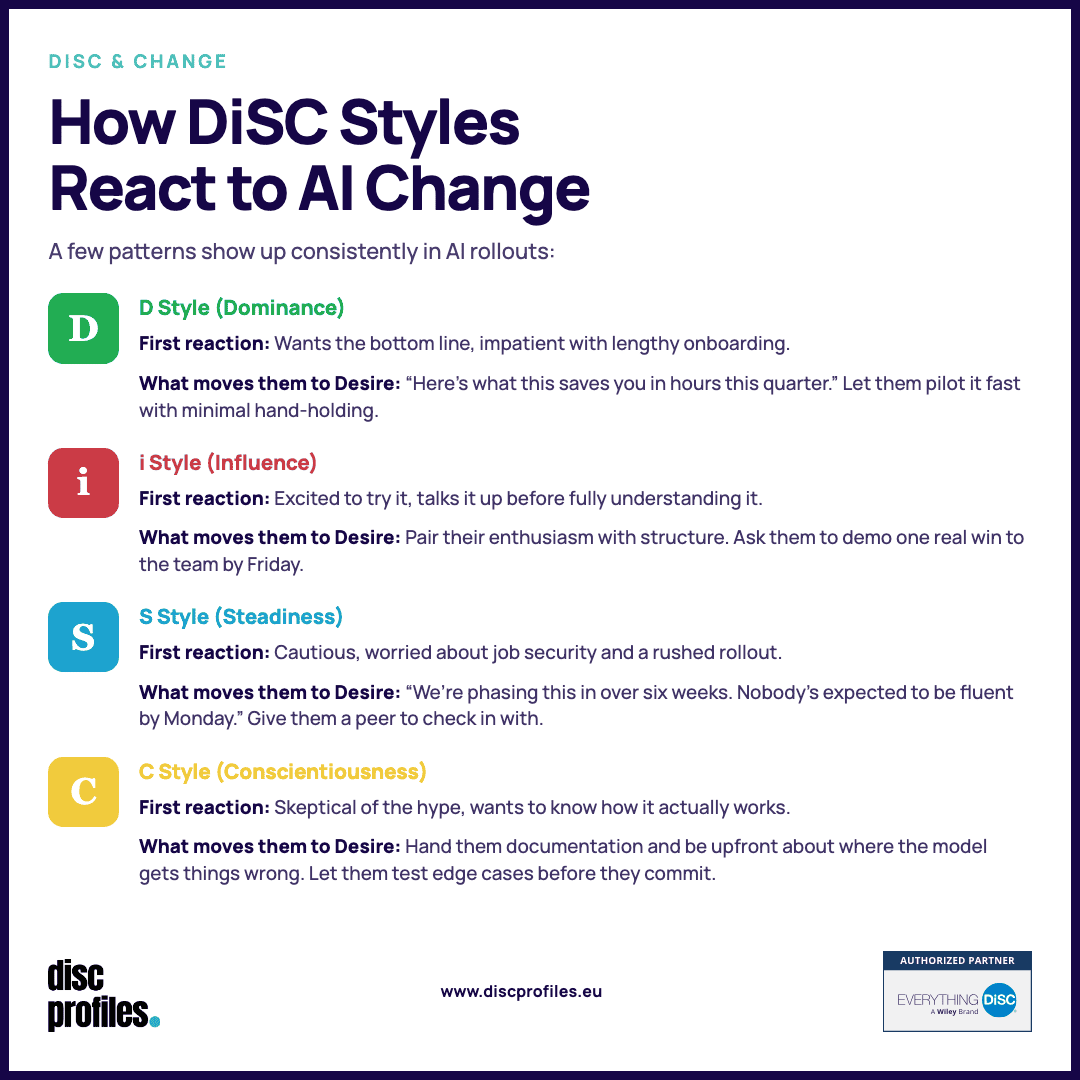
ADKAR tells you the stages. It doesn’t tell you that a Dominance-style employee and a Steadiness-style employee will move through those stages at completely different speeds, or that they need to hear the announcement differently to get there. That’s the piece Everything DiSC adds: a way to see how each person’s default style shapes their reaction to change, so the Awareness and Desire stages actually land instead of getting waved at in an all-hands slide.
A few patterns show up consistently in AI rollouts:
None of this replaces training. It changes how the training is delivered, and to whom, and in what order. A rollout that leads with a company-wide demo will win over the i styles and lose the C styles in the same room.
What this looks like on a personal level
Change management usually gets framed as an org chart problem, but the AI gap is also showing up one person at a time. Someone on your team might already be excellent at prompting a model and too unsure of themselves to say so out loud, especially if they’re an S or C style who doesn’t want to look like they’re showing off or getting something wrong in public.
Knowing your own DiSC style helps here too. If you’re a D, you might be adopting AI faster than your team and mistaking their caution for resistance rather than a legitimate need for more Ability-stage support. If you’re an S or C, naming that you want more time before you’re comfortable is accurate self-knowledge, not a sign you’re falling behind. It’s exactly the kind of thing a tool like Everything DiSC Catalyst is built to surface, since it gives people language for their own working style instead of leaving them to guess.
A short playbook
If you’re planning an AI rollout this year, a few moves consistently help close the gap:
- Start with Awareness and Desire before you touch Knowledge. Explain why the change matters to each team, not just what the tool does.
- Get managers using the tools first. Gallup’s data on manager championing suggests this matters more than the training budget.
- Build in Reinforcement. A single launch webinar isn’t a change program. Check in at 30, 60, and 90 days.
- Adjust your messaging by style. D wants the results. Give i a story worth telling. S needs a timeline before signing on, and C won’t move without documentation.
The organizations that get this right usually don’t have the newest AI tools. They ran the rollout as a change management project that happened to involve new software. If you want help building that kind of plan, whether that’s a facilitated DiSC certification for your L&D team or a workshop for a specific group, get in touch and we’ll walk through what fits your organization.
Enjoyed this? Get more like it.
One short email whenever we publish something new about DiSC, teams and workplace behaviour. No spam.